Every family tree tells a series of stories.
We nod at it because we know it’s true. But after spending three weeks going through Genesis 10, I understand that it’s dry for Western readers. It’s not engaging to study genealogies. I’m there with you. It’s not up there with the most exciting parts of the Bible.
That’s not to say it’s not essential. After all, with all the information and wisdom the Holy Spirit could have inspired the Biblical writers to give, we have what we have. We received that information and wisdom. And that includes genealogies.
Boredom with genealogies appears to be a Western mindset. When I have met sisters or brothers in Jesus from Eastern cultures (or let’s say, “non-Western”), genealogies are far more important. In other cultures, family origin is more critical. I met someone from Hong Kong who said the genealogies were their favorite part of the Bible—and they aren’t alone!
Westerners (like me and most of my readers) tend to think individualistically. We are concerned with ourselves more than our place in our families. Other cultures have a very different view of family and self. The Bible is an Eastern document and has a family/cultural mindset. Those last few sentences will help us correctly interpret Genesis more effectively.
Consider that when you read a genealogy in the Bible. As we move through Genesis 10, we’re at the final section: Genesis 10:21-32.
21 Sons were also born to Shem, whose older brother was Japheth; Shem was the ancestor of all the sons of Eber.
Genesis 10:21-32, New International Version
22 The sons of Shem: Elam, Ashur, Arphaxad, Lud and Aram.
23 The sons of Aram: Uz, Hul, Gether and Meshek.
24 Arphaxad was the father of Shelah, and Shelah the father of Eber.
25 Two sons were born to Eber: One was named Peleg, because in his time the earth was divided; his brother was named Joktan.
26 Joktan was the father of Almodad, Sheleph, Hazarmaveth, Jerah, 27 Hadoram, Uzal, Diklah, 28 Obal, Abimael, Sheba, 29 Ophir, Havilah and Jobab. All these were sons of Joktan.
30 The region where they lived stretched from Mesha toward Sephar, in the eastern hill country.
31 These are the sons of Shem by their clans and languages, in their territories and nations.
32 These are the clans of Noah’s sons, according to their lines of descent, within their nations. From these the nations spread out over the earth after the flood.
Shem’s family tree is the line that leads to the Jewish people and, ultimately, Jesus. In the Bible, this is the prominent family line. Visually, this is what Shem’s family tree looks like.
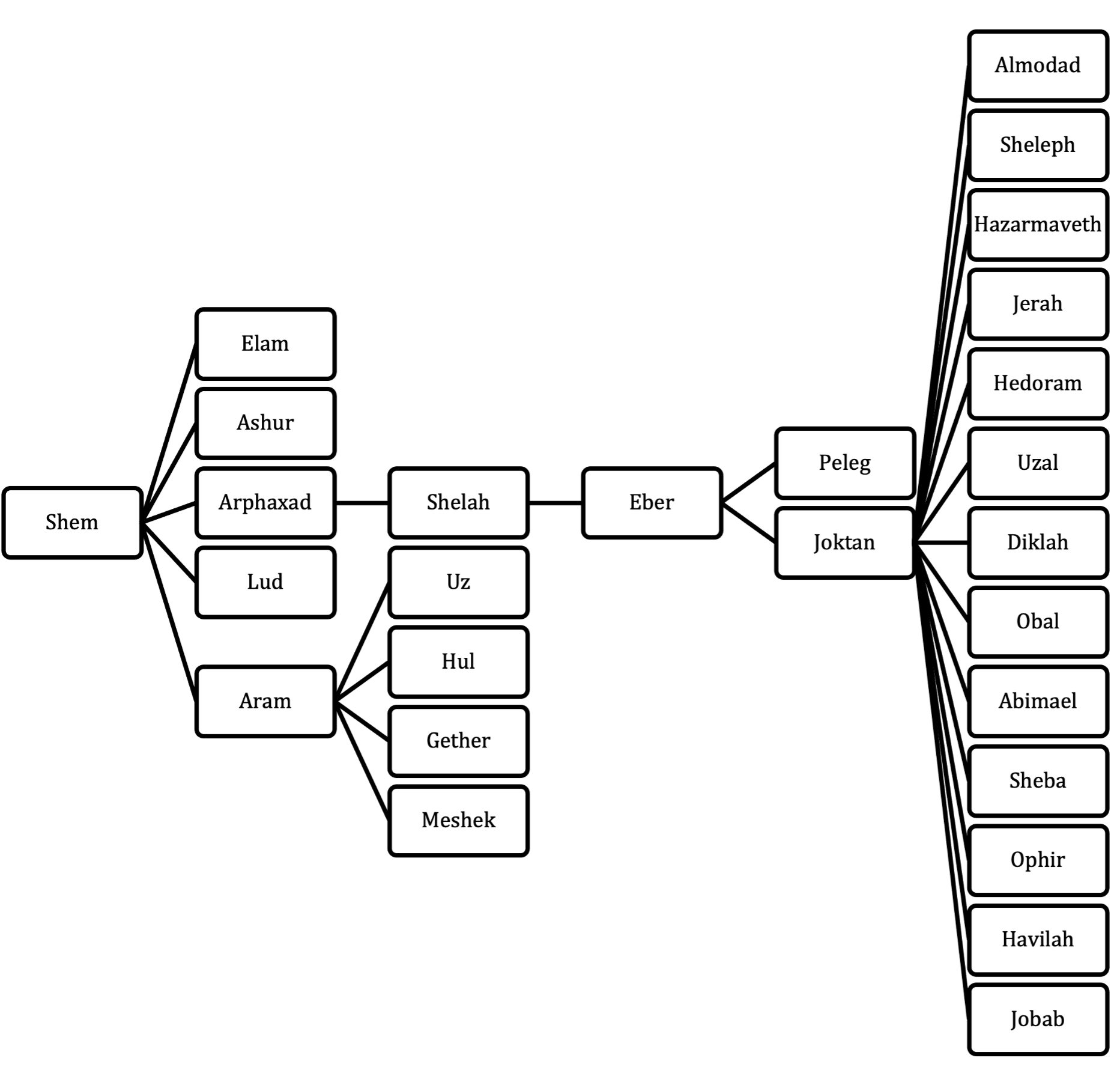
Noah’s firstborn, Shem, and his descendants grew into the dominant nations of the Middle East. They settled in regions like modern Iran (Elam), Iraq (Ashur), Assyria (Aram), and Saudi Arabia (Joktan).
Most significantly, Eber settled in Ancient Mesopotamia. Eber is the ancestor of Terah, Abraham’s father. It’s through the line of Eber (and ultimately, Shem) that Abraham, Isaac, and Jacob are descendants of Eber (and ultimately, Shem).
Interestingly, the word and designation of “Hebrew” is probably a derivative of Eber.
For those who have studied Genesis before, you quickly notice how Peleg’s lineage is dropped while Joktan’s is listed. In chapter 11, we find Peleg’s lineage spelled out as the line of blessing from the Lord. At this point, however, Peleg’s isn’t mentioned more.
Several theories exist on why this is. Let’s remember that the original readers of Genesis would have been very aware of the line of Peleg and Joktan. In short, we don’t know. We can only say that Genesis 11 does complete the legacy of Peleg. Perhaps the Holy Spirit was avoiding redundancy. Again, we really don’t know.
Genesis 10:32 summarizes the “table of nations” found in Genesis 10. It’s the other bookend to this chapter. It adds an important detail: “From these the nations spread out over the earth after the flood” (Genesis 10:32b). It’s in Genesis 11 where we find out why.
All modern humanity goes back to these family lines. Just as we’ve discussed in Genesis 1 and 2, all of humanity shares a common ancestry.
As we finish Genesis 10, I want to remind you that the chapter and verse numbers are modern inventions. The versification was added after the invention of the printing press. It’s a convenience. It’s important to remember that because we finish Genesis 10 and mentally put it aside. Instead, Genesis 10 and 11 are one thought, one story. It conveys one idea.
We’ve seen part 1: the Lord is the creator of all humanity and cultures.
Next week, we’ll start seeing the second half of the idea of Genesis 10 and 11.
 Life Meets Theology