Familiarity breeds contempt

Have you ever heard that expression? It conveys that if you are very aware of a person or situation, you can quickly become careless towards the person or situation.
We see this when we’re driving. Pop quiz: on the street you drive on to go home, what’s the speed limit? Most of us aren’t sure. Yet, we drive on it every day. How can we not know? But we’re so familiar with it that we become careless about it. In other words, “familiarity breeds contempt.”
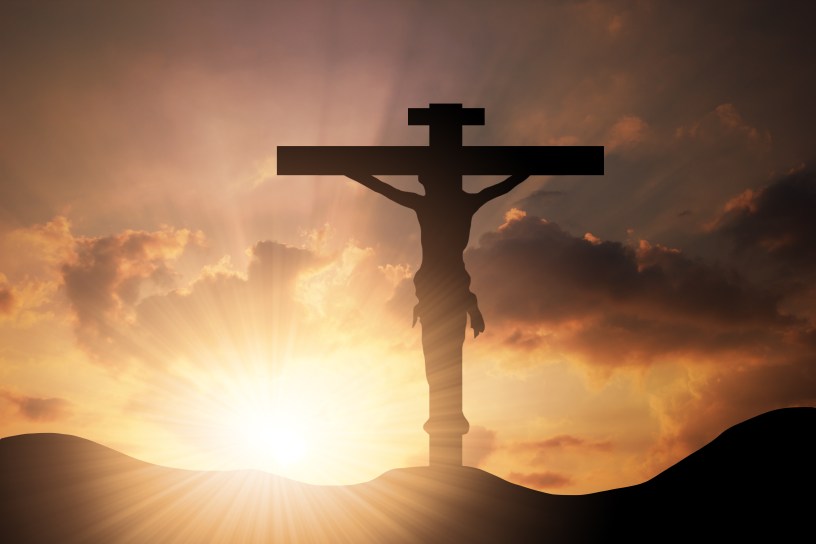
This can also be true for the crucifixion of Jesus. If you’ve been a Jesus-follower for a few years (or decades!), the events of the crucifixion seem so basic that we become careless with it. It’s so simple that we don’t read it much anymore.
Today, as we enter the events of the crucifixion in our study of the Gospel of John, read today’s passage with fresh eyes. I suggest reading John 19:16b-27 slowly and out loud. Make yourself see the words.
So the soldiers took charge of Jesus. Carrying his own cross, he went out to the place of the Skull (which in Aramaic is called Golgotha). There they crucified him, and with him two others—one on each side and Jesus in the middle.
John 19:16b-27, New International Version
Pilate had a notice prepared and fastened to the cross. It read: Jesus of Nazareth, the King of the Jews. Many of the Jews read this sign, for the place where Jesus was crucified was near the city, and the sign was written in Aramaic, Latin and Greek. The chief priests of the Jews protested to Pilate, “Do not write ‘The King of the Jews,’ but that this man claimed to be king of the Jews.”
Pilate answered, “What I have written, I have written.”
When the soldiers crucified Jesus, they took his clothes, dividing them into four shares, one for each of them, with the undergarment remaining. This garment was seamless, woven in one piece from top to bottom.
“Let’s not tear it,” they said to one another. “Let’s decide by lot who will get it.”
This happened that the scripture might be fulfilled that said,
“They divided my clothes among them and cast lots for my garment.”
So this is what the soldiers did.
Near the cross of Jesus stood his mother, his mother’s sister, Mary the wife of Clopas, and Mary Magdalene. When Jesus saw his mother there, and the disciple whom he loved standing nearby, he said to her, “Woman, here is your son,” and to the disciple, “Here is your mother.” From that time on, this disciple took her into his home.
Was there anything that suddenly seemed to jump out to you—as if you’d never seen it before? I know I have that experience nearly every time I read this passage.
Jesus is taken away from Pilate at the Praetorium and is now ready for crucifixion. Nearly in shock and bleeding profusely, Jesus was still forced to carry His own cross. Pilate gave in to the Jewish religious leaders, but he still needed a legal reason to have Jesus executed. The reason is stated on the sign over the cross: sedition.

Claiming to be the king in Rome was punishable by death. This satisfied the Roman Law.
But there was more happening here. Jesus wasn’t a victim of Roman or Jewish politics. He was a servant of His Father. He was the Son of God. Jesus was fulfilling His mission and purpose on this earth. We’re talking about that next week.
But now, consider some of the different reactions to Jesus:
- Pilate got rid of Him for political expediency.
- The Jewish leaders still couldn’t hate Him enough.
- Soldiers mocked Him and gambled for His robe.
- His mother stood faithfully with Him.
- John (our author) watched, powerless to help Him.
Are we much different today? Jesus is divisive. Always has been. We see it at the crucifixion and in our culture today.
But what’s your reaction to Jesus? Does familiarity with Him make you careless towards Him? I pray that you will see Him daily with fresh eyes—the eyes of wonder like a child.
 Life Meets Theology